Introduction
There is a moment every SFX makeup artist remembers.
The prosthetic is on. Edges blended. Structure right. But something looks fake. And you cannot figure out why.
Get color right and people wince. Get it wrong and the illusion collapses – no matter how good your sculpting or application.
And yet color theory is the most neglected skill in SFX makeup. Beginners focus on wax, latex, prosthetics. Color becomes an afterthought. Something you figure out as you go. The result? Technically decent work that never quite looks real.
This guide fixes that.
Why Color Theory Changes Everything
Here is the truth. Your brain has spent your entire life looking at human faces. It knows exactly what skin looks like. What a bruise looks like on day one, day three, day seven. The color of a fresh cut versus a healing scar. It knows when something is wrong, even if you cannot consciously explain why.
That is your biggest challenge as an SFX artist. You are not just trying to fool a camera. You are trying to fool a brain that has been studying human faces since birth.
Color theory gives you the tools to do exactly that.
When you understand color – really understand it – you stop guessing. You look at a bruise reference and immediately know what colors you need, how to mix them, and how to apply them. You look at a prosthetic and know exactly why it does not match the surrounding skin – and exactly how to fix it.
That kind of certainty transforms your work.
What This Guide Covers
This is the most comprehensive free guide to color theory for SFX makeup artists on the internet. It covers everything – from the science of how we see color to the specific palettes for wounds, bruises, burns, aging skin, and creature design.
Here is what you will learn:
- How the human eye perceives color – and why this matters for SFX
- The color wheel and how to use it practically
- Value and saturation – the two most misunderstood properties in SFX color work
- How to match any skin tone accurately
- The exact color palettes for wounds, bruises, burns, scars, and aging effects
- How to paint prosthetics so they disappear into the skin
- How lighting destroys or enhances your color work
- How to mix any color you need from a small core palette
- How to train your color eye so good color judgment becomes instinctive
Every section is practical. No abstract art school theory – just the knowledge you need to make your work look genuinely real.
How to Use This Guide
Read it from start to finish if you are new to color theory. Each section builds on the last, and the foundations matter.
Already know the basics? Jump straight to the section most relevant to you. Each section works as a standalone reference.
Most importantly – practice as you read. Color theory is not something you learn by reading alone. You learn it by mixing colors, making mistakes, studying reference photographs, and training your eye over hundreds of practice sessions.
Keep this guide open on your workbench. Refer back to it constantly. Let it inform every color decision you make.
Your work is about to get significantly better.
Let us start.
The Science of Color – How We Actually See Color
Before we mix bruise colors or match skin tones, we need to understand how color actually works. This is not academic. It explains why the same color looks different in different lighting, why a perfect match in your workspace looks wrong on camera, and why your brain detects slightly-off skin color instantly.
Light is Color
Color does not exist in objects. It exists in light. A surface absorbs some wavelengths and reflects others. The reflected wavelengths are what you perceive as color. Change the light source – daylight, tungsten, stage lighting – and you change which wavelengths hit your makeup. The makeup hasn’t changed. The light has. And that changes everything about how the color appears.
How Your Eye Sees Color
our eyes have three types of cone cells, each sensitive to red, green, and blue wavelengths. Your brain combines these signals to produce the full range of color you perceive. This three-channel system is why RGB color models exist – they mirror human color perception.
The critical implication: color perception is relative, not absolute. Your cones compare colors against surrounding colors. The same color looks different depending on what sits next to it.
Why Context Changes Everything
This is called simultaneous contrast. Place the same grey on a white background versus a black background – it looks darker against white, lighter against black.
For SFX: a prosthetic color that matches perfectly on your palette will look different once surrounded by real skin. Test your color mixes directly on or next to the skin you are working on. Never trust the palette alone.
The Three Properties of Color
Every color has three fundamental properties. Controlling all three separates professional color work from amateur work.
- Hue – what most people mean by “color.” Red, blue, yellow, purple. A bruise’s hue is purple-red. A healing bruise shifts to yellow-green. Hue is your starting point.
- Value – the lightness or darkness of a color. Light blue and dark blue share the same hue but different values. Value is arguably more important than hue for SFX. It creates depth in a wound, shadow in a wrinkle, the raised look of a scar. Beginners focus on hue and neglect value. That is why beginner work looks flat.
- Saturation – the purity or vividness of a color. A highly saturated red is vivid and pure. A desaturated red looks muddy, greyish, or brownish. Real skin and real injuries are far less saturated than beginners expect. Oversaturation – colors too vivid to look like real tissue – is the fastest marker of amateur work.
Additive vs Subtractive Color Mixing
There are two ways colors mix.
Additive (mixing light) is the RGB model used in screens and cameras.
Subtractive (mixing pigments) is what happens when you mix paints and makeup products – each pigment absorbs wavelengths, so adding more pigments makes the mixture darker and muddier.
For your SFX practice: use as few pigments as possible to achieve your desired color. That is subtractive mixing.
Why the Same Makeup Looks Different on Camera
Your eyes adapt to lighting automatically. White paper looks white to you whether you are in warm tungsten light or cool daylight – your brain compensates. A camera does not. It records what is actually there, not what your adapted vision perceives.
Practical implication: test your makeup under the actual shoot lighting and view it through the camera, not just with your naked eye. What you see and what the camera records can be significantly different.
The Most Important Takeaway from This Section
Color is not a fixed property of objects. It is light interacting with surfaces, interpreted by a biological visual system.
Three principles for your SFX practice:
- Assess color in context – never in isolation. What works on your palette may fail on skin.
- Lighting changes everything – the same makeup under different light looks like different makeup.
- Value and saturation matter as much as hue – most beginners focus only on hue. Mastering all three is what professionals do.
Keep these in mind as you work through the rest of this guide.
The Color Wheel – Your Most Important Tool
Every SFX makeup artist needs to truly understand the color wheel – so deeply that you apply its principles instinctively. It is not a beginner concept you outgrow. Professional SFX artists use it daily. Every time you neutralize an overly red prosthetic, adjust a bruise color, or make a creature skin tone convincing, you are using color wheel principles. Learn it properly and color mixing becomes logical and fast. Skip it and you are guessing.
The RYB Color Model – Why SFX Artists Use It
The model you need is RYB – red, yellow, blue. It reflects how physical pigments behave when mixed. It is intuitive, practical, and perfectly suited to the subtractive color mixing you do every time you work with SFX materials.
Primary Colors
Red, yellow, and blue are the foundation. You cannot create them by mixing other colors. In theory, you can mix any color you need from just these three primaries plus white. In practice, working with a small palette of high-quality primaries forces you to develop a deep understanding of color mixing that buying pre-mixed colors never will.
Secondary Colors
Mix two primaries in equal proportions:
- Red + Yellow = Orange
- Yellow + Blue = Green
- Red + Blue = Purple
These three secondary colors are enormously important in SFX. Green and purple appear in bruising. Orange and yellow appear in aging skin. The most common beginner mistake is mixing muddy secondary colors – almost always due to contamination. Mix with clean tools on a clean surface.
Tertiary Colors
Mix a primary with the adjacent secondary:
- Red-orange
- Yellow-orange
- Yellow-green
- Blue-green
- Blue-purple
- Red-purple
Real skin, real injuries, and real creature colors live in the tertiary range. A fresh bruise is not simply purple. In the first hours, it appears red, red-purple, or dark purple as blood pools under the skin. Over the following day or two, as oxygen leaves the hemoglobin, it deepens to a blue-purple or near-black at its center. The edges, where the blood is thinner and more dispersed, stay in the red-purple range. As the bruise heals over several days, the body begins breaking down hemoglobin into biliverdin and bilirubin – producing the characteristic green and yellow tones of a fading bruise. Understanding this staging gives you the tools to mix not just a bruise, but a bruise at a specific point in time.
Complementary Colors – Your Most Powerful Tool
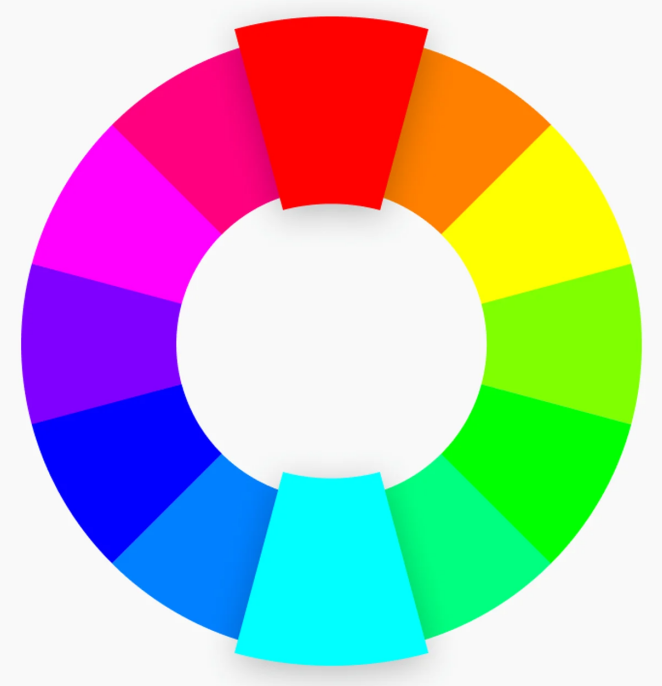
Complementary colors sit opposite each other on the color wheel:
- Red and Green
- Yellow and Purple
- Blue and Orange
They have two remarkable properties for SFX work.
Property one – maximum contrast. Placed side by side, complements make each other appear more vivid. A red wound surrounded by the greenish tones of healing tissue looks striking for exactly this reason.
Property two – mutual neutralization. Mixed together, complements neutralize each other. Add a tiny amount of green to red and it becomes more brownish, more muted, more like dried blood. Mix complements equally and you get neutral grey or brown.
This neutralization is one of your most valuable tools. Real skin and injuries are never as vivid as pure colors from a palette. They are always neutralized.
Practical complementary applications:
- Bruise purple too vivid? Add a tiny amount of yellow.
- Wound red too bright? Add a touch of green.
- Prosthetic skin tone too orange? Add a small amount of blue.
Analogous Colors – Building Harmony
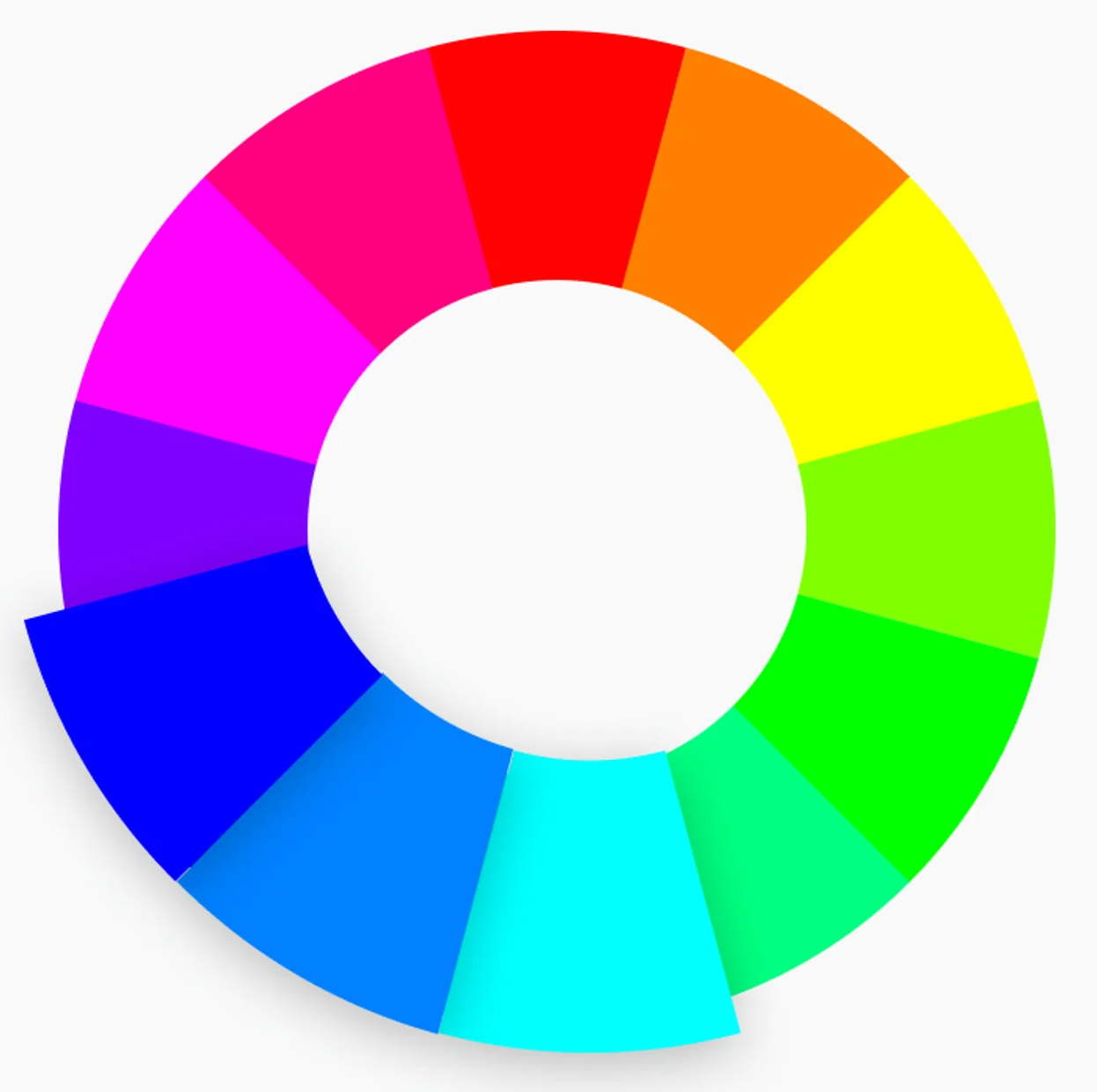
Analogous colors sit next to each other on the wheel – like red, red-orange, orange, yellow-orange. These combinations are naturally harmonious and appear frequently in nature, including human skin. Real skin does not contain a single flat color – it shifts gradually across an analogous range. When painting a prosthetic, layer slightly different analogous tones across the surface. Your skin work will immediately look more alive and complex.
Split Complementary, Triadic, and Tetradic Schemes
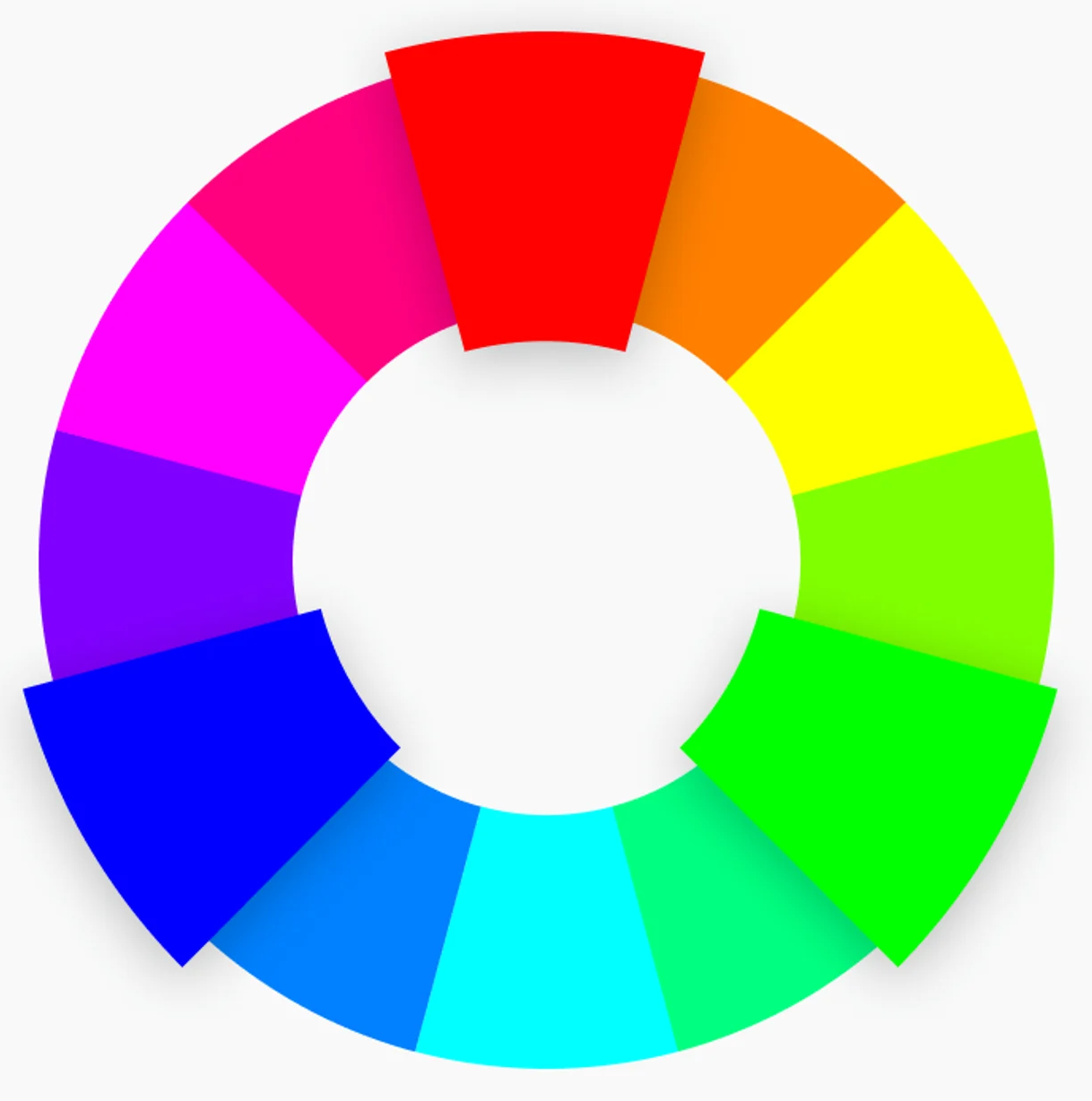
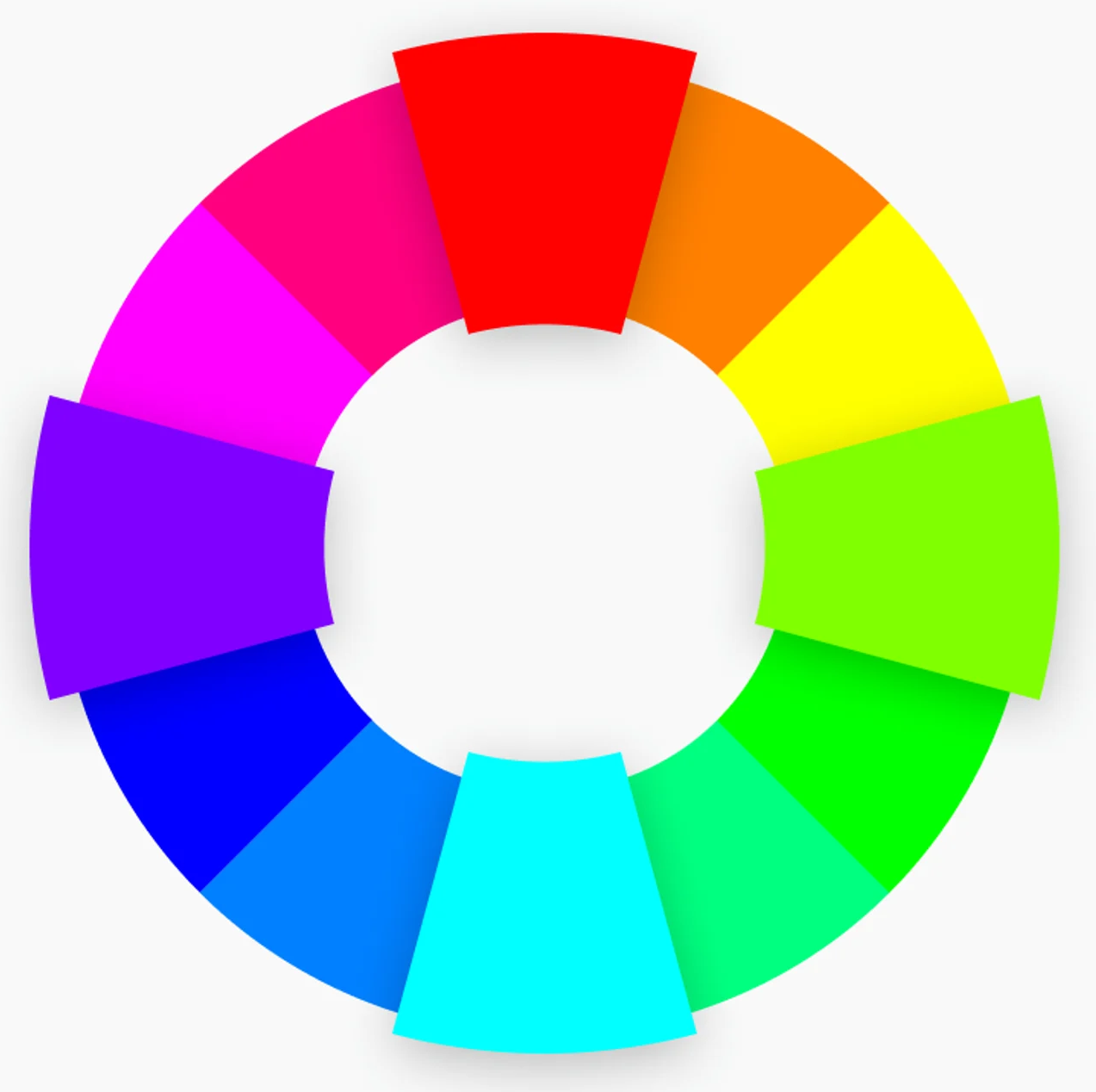
Triadic uses three equally spaced colors on the wheel. The secondary triad – orange, green, and purple – is the more useful set for SFX work, since these three colors together cover the full range of bruising, inflammation, and healing you need to paint realistic injury. A well-staged bruise will naturally contain all three.
Tetradic uses two complementary pairs. All are useful for bold, dynamic designs but rarely appear in realistic
Warm and Cool Colors
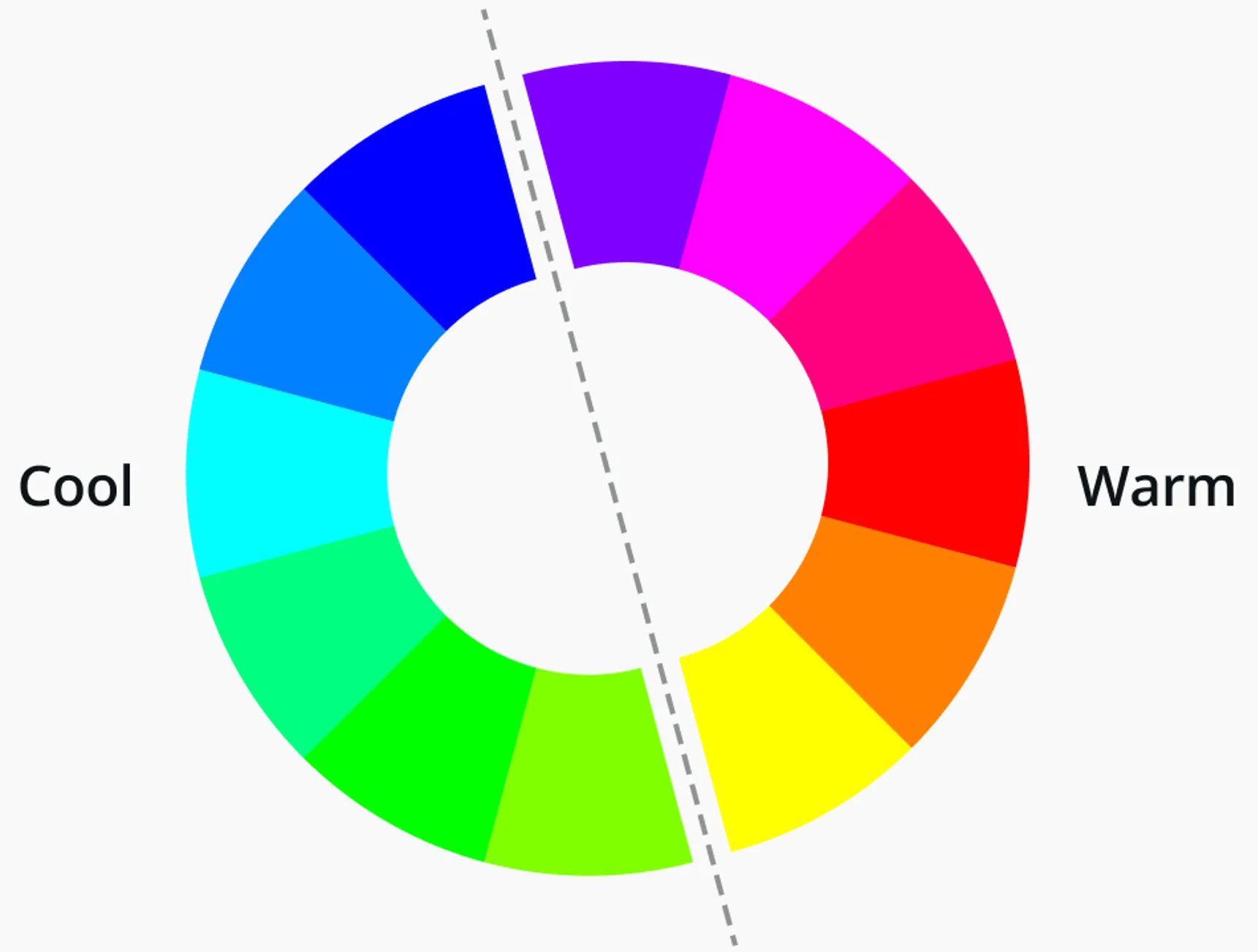
Warm colors (reds, oranges, yellows) advance visually – they appear to come forward. Cool colors (blues, greens, purples) recede – they appear to move back.
In SFX: warm colors go on raised, light-facing areas. Cool colors go in shadows and recesses. In injuries: warm colors (reds, oranges) dominate fresh inflammation and bleeding. Cool colors (blues, purples, greens) appear in deeper tissue damage and healing stages.
Practical Exercises for Learning the Color Wheel
Do these before moving on. They will make everything that follows more meaningful.
Exercise 1 – Mix a complete color wheel
Using only red, yellow, blue, and white, mix all twelve colors – three primaries, three secondaries, six tertiaries. No pre-mixed colors.
Exercise 2 – Complementary neutralization
Take each complementary pair (red/green, yellow/purple, blue/orange) and mix them together in gradually increasing proportions, creating a gradient from one pure color to the other. Observe the neutral mid-point.
Take each complementary pair and mix them in gradually shifting proportions, more of one, then equal, then more of the other. Pay close attention to the neutral midpoint where the two colors cancel each other out. Note that it is brown rather than a true grey.
Exercise 3 – Analogous skin tone study
Look at the back of your hand in natural daylight. Find the warmest area, likely where blood vessels or tendons are close to the surface. Find the coolest area – likely in the shadows between fingers or knuckles. Find the most neutral area. Map all three onto the color wheel. Notice that no area is a single flat color.
Exercise 4 – Bruise color wheel
Mix the complete range of bruise colors in chronological order – fresh impact (red, red-purple), hours later (deep blue-purple), days later (blue-green at the edges), healing (yellow-green, yellow). Arrange them in sequence and map each stage onto the color wheel. Keep this as a permanent reference.
Understanding Value – Light and Shadow
Value is more important than color.
If your values are right, your SFX work will look convincing even if your colors are slightly off. If your values are wrong, your work will look flat and fake no matter how perfectly you mix your colors. Understanding value and controlling it deliberately is one of the biggest improvements you can make to your SFX work – and most beginners completely overlook it.
What Value Actually Means
Value is how light or dark a color is. A pale pink and a deep burgundy are both red in hue, but they have very different values – pale pink is high value, deep burgundy is low value. White is the highest possible value. Black is the lowest.
Here is a simple test. Photograph your SFX work and convert it to black and white. Strip away the color and look only at the light and dark values. If the black and white version looks flat – everything in a similar mid-grey range – your values are the problem. Fix the values and the color work will immediately look more convincing.
Why Value Creates Form
The visual system uses light and shadow to understand three-dimensional form. A scar painted as a flat, uniform color looks like a drawing on skin. A scar that is lighter on its raised edges and darker in its recessed center has value contrast – and that contrast makes it read as three-dimensional. A wound with deep, dark values at its center, graduating to lighter values at its edges, reads as deep and genuinely alarming. Value creates form. Form creates realism.
The Value Scale – and How to Shift Values Correctly
You can shift any color up or down the value scale by adding white or black. But here is what beginners miss. Adding white changes hue and reduces saturation – red becomes pink, cooler and less saturated. Adding black produces muddy, lifeless results.
The professional solution: lighten colors using a lighter version of the same hue or a closely analogous hue, not pure white. To lighten a red wound color, add a lighter red or pale orange. Darken colors by adding a darker version of the same hue or a darker complementary color. To darken a red, add a dark burgundy or deep blue-red, not black.
Highlight and Shadow Placement on the Face
Light typically comes from above. The highest points of the face – forehead, top of nose, cheekbones, chin – receive the most light and appear lightest. The recessed areas – eye sockets, sides of the nose, hollows beneath cheekbones – fall into shadow. When painting a prosthetic, make raised areas slightly lighter (warm highlights) and recessed areas slightly darker (cool shadows). When creating a wound, deepen the interior and lighten the inflamed edges.
Value in Wound and Injury Simulation
- Cuts – Interior: darkest values (deep crimson, near-black). Edges: lighter, warmer (bright red, inflamed pink). Surrounding skin: graduates from inflamed pink to normal tone.
- Bruises – Darkest at the center, graduating to lighter at the periphery. As healing progresses, the dark center lightens and overall contrast compresses.
- Burns – Charred areas: near-black. Blistered areas: pale and translucent. Inflamed tissue: mid-value with strong redness. This range from very dark to very light creates realism.
- Aging effects – Wrinkles are depressions (dark values). The skin between wrinkles catches light (lighter values). Building value contrast into aging makeups makes them read as genuinely old, not simply textured.
The Black and White Test (Use This Regularly)
Convert a photo of your work to black and white. Good value structure has clear contrast between light and dark, distinct highlights on raised surfaces, deep shadows in recesses, and a full range from near-white to near-black. Poor value structure has everything in a similar mid-grey range.
If your work fails the test, add more contrast. Deepen shadows. Brighten highlights. Push the value range further than feels comfortable – cameras and stage lighting compress values compared to what you see in your workspace.
Common Value Mistakes
- Everything the same value – The most common mistake. Push your values further apart.
- Pure white highlights / pure black shadows – Produces a harsh, theatrical look. Use tinted highlights (warm yellows, pale pinks) and colored shadows (dark reds, deep browns, blue-greys).
- Shadows too warm – Real shadows have a cool quality. Blue-grey, cool purple, and dark green-grey are more convincing.
- Highlights too cool – Real highlights on skin have warmth. Avoid bluish highlights.
- Ignoring reflected light – Shadow areas receive subtle secondary illumination, often slightly cooler than the primary light. Adding this adds realism.
A Simple Value Exercise
Take a reference photo of a real bruise, wound, or aged face. Convert it to black and white. Study the value structure. Where are the lightest areas? The darkest? How much contrast?
Now recreate only the value structure using black, white, and grey paint – no color. Focus only on matching the values you see in the black and white reference. Do this repeatedly with different references. It is one of the fastest ways to learn to see value independently of color.
Understanding Saturation and How to Control It
Look at a fresh SFX paint color next to your skin or a real bruise reference. The paint is almost certainly more vivid, more intense, more pure than anything in real human tissue. This gap between the vividness of your paints and the muted complexity of real tissue is one of the central challenges of SFX color work. Saturation is the concept that explains it – and gives you the tools to close that gap.
What Saturation Actually Means
Saturation – also called chroma or intensity – is the purity or vividness of a color. A highly saturated color is pure and intense. A desaturated color is muted, complex, and greyish. Saturation is independent of hue and value. You can have a light desaturated color (dusty pale pink) or a dark saturated color (deep vivid purple).
Why Real Skin and Injuries Are Less Saturated
Real human tissue is complex. Skin is a translucent multi-layered structure – melanin, haemoglobin, carotene, and structural color all contribute. A bruise contains blood at various oxidation stages, inflammatory fluid, and disrupted tissue. The result is always more muted and complex than any single pure pigment. If you paint with full-saturation colors straight from the pot, your work will almost always look fake – not because the hue is wrong, but because it is too pure. Learning to desaturate colors appropriately is one of the fastest improvements you can make.
How to Desaturate Colors
- Add the complementary color – Most controlled and professional. A tiny touch of green to red makes it more like real blood. A small amount of yellow to purple makes it more like a real bruise. Start very small and add gradually.
- Add grey – Simple and effective, but can produce flat, dead-looking colors if overused. Use sparingly.
- Add an earth tone – Raw sienna, burnt umber, yellow ochre. These add warmth and organic complexity while reducing saturation. Particularly useful for skin tones and aging effects.
- Layer transparently – Build up thin, transparent layers that optically mix on the surface. This produces the most complex and lifelike results. The best prosthetic painters use dozens of thin layers rather than one opaque mix.
Saturation in Different SFX Applications
- Fresh wounds – Moderately saturated. Rich warm red, but not maximum vividness. Inflamed surrounding tissue is muted pink-red. Deeper tissues are dark, complex reds and browns.
- Bruises – Low to moderate. The dramatic day-one bruise is a desaturated blue-red-purple, not vivid violet. Healing yellow-green is very desaturated – dusty, not lime.
- Burns – Varies. First-degree: moderate saturation, vivid red. Second-degree: less saturated, pale and complex. Third-degree: very desaturated – near-black, pale white, brownish-grey.
- Aging skin – Low saturation overall. Colors become more muted and neutral. Age spots are desaturated brown. Rosacea is dusty pink-red.
- Creature skin – Can use higher saturation, but the most convincing designs balance vivid areas with muted, desaturated tones to avoid looking like body paint.
- Prosthetic blending – Low saturation, matching the subject’s natural skin. Over-saturated blending areas are a common reason prosthetics fail to disappear.
The Saturation Trap
You apply an effect. It looks good in your workspace. On camera, it looks garish and fake. Two reasons: camera sensors record colors at higher apparent saturation than the eye perceives, and your visual system adapts to the saturation you are working with, making objectively oversaturated colors look normal. The fix: work at lower saturation than feels right. Desaturate more than feels comfortable. Always check through a camera.
Saturation and Skin Tone Matching
Most commercial makeup products are formulated at higher saturation than natural skin. When matching skin tone for prosthetic blending, assess the saturation of the natural skin first. Compare your mixed color. Is it more saturated? Almost certainly. Desaturate until hue, value, and saturation all match. Most beginners match hue but neglect the other two. Matching all three is what separates a convincing blend from a visible one.
A Saturation Exercise
Take a reference photo of a real injury. Mix a color that matches its most prominent color. Hold it next to the reference. Your mix will almost certainly be more saturated. Now desaturate using the complementary method until the saturation genuinely matches. Notice how much desaturation was required. That gap is your saturation calibration error. Repeat with five different injury references. Your intuitive sense of appropriate saturation will shift significantly toward realism.
The Key Takeaway
Oversaturation is the most consistent and damaging mistake in SFX color work. Desaturate. Then desaturate a little more. Your work will thank you.
Skin Tones – The Most Complex Color Challenge
Matching skin tone is the hardest color challenge in SFX makeup. Human skin is not a single color or layer. It is a translucent, multi-layered structure containing multiple pigments, a vascular network, fat, and bone – all shifting across different areas of the face, under different lighting, across different ages and ethnicities.
The Biology of Skin Color
- Melanin – Provides brown, tan, and dark tones. More melanin = darker skin. Distribution varies across the face.
- Haemoglobin – The red pigment in blood. Gives skin its pink and red tones, especially in cheeks and nose.
- Carotene – A yellow-orange pigment in subcutaneous fat. Adds warm undertones.
- Structural color – Light scattering in the skin (Tyndall effect) contributes cool blue and purple tones in thin-skinned areas like under the eyes.
Undertones – The Most Important Concept
Undertones are the underlying color bias beneath the surface color. Matching the undertone is just as important as matching the shade.
- Warm undertones – Yellow, peachy, golden bias. Pulls toward yellow and orange.
- Cool undertones – Pink, red, bluish bias. Pulls toward pink and blue-red.
- Neutral undertones – Balance of warm and cool. Most challenging to match.
How to Identify Undertones
- Vein test – Look at wrist veins in natural light. Blue/purple = cool. Green = warm. Mixed = neutral.
- Jewelry test – Gold flatters warm undertones. Silver flatters cool undertones.
- White paper test – Hold white paper next to the face. Yellow-golden against white = warm. Pink-rosy = cool.
- Direct observation – Look past the overall shade and look for underlying color bias.
Mixing Skin Tones from Primary Colors
Start with a warm mid-tone base: roughly one part red, two parts yellow, four to six parts white gives a pale to medium warm flesh tone.
- Adjust undertone – More yellow/orange = warmer. A touch of red or tiny amount of blue = cooler.
- Adjust value – White to lighten (but it reduces saturation). Burnt sienna or raw umber to darken (not black).
- Adjust saturation – Add a tiny touch of complementary color to desaturate.
- Test in context – Apply next to the skin. Adjust. Repeat.
Essential palette for skin tone mixing:
- Titanium white
- Cadmium red or red oxide
- Yellow ochre
- Burnt sienna
- Raw umber
- Ultramarine blue (small amount for cool adjustments)
- Viridian or phthalo green (small amount for desaturation)
With these seven colors you can mix virtually any human skin tone.
Skin Tone Variation Across the Face
- Central face (nose, cheeks, forehead) – Warmer, more saturated, more red (higher vascular density).
- Periorbital area (under eyes) – Cooler, more desaturated (thin skin reveals structural blue).
- Lip area – Pinker, more saturated (superficial blood vessels).
- Hairline and jaw – Slightly cooler (less sun exposure, lower vascular density).
- Bony prominences – Slightly lighter in value (skin stretched thin over bone).
Replicating these variations – not painting a flat uniform tone – gives prosthetics a living, organic quality.
Skin Tones Across Ethnicities
- Every skin tone has an undertone – warm, cool, or neutral. This applies to deep skin tones as well as fair ones.
- Darker skin is not simply a darker version of fair skin. Deep tones have their own color qualities – warm mahogany, cool blue-black, rich red-brown.
- In very fair skin, haemoglobin (pink-red) is highly visible. In darker skin, melanin masks haemoglobin, and undertone is determined by the melanin’s own qualities.
- Periorbital darkness and sun damage patterns vary across ethnic groups. Adjust your techniques accordingly.
The Effect of Age on Skin Tone
- Melanin distribution becomes uneven – age spots (hyperpigmentation) alongside reduced pigmentation.
- Haemoglobin contribution increases – thinner, more transparent skin makes blood vessels more visible (more redness, more blue-purple in thin areas).
- Carotene contribution decreases – thinning fat layer reduces warm yellow-orange tones.
- Overall saturation decreases – aged skin is more muted and complex.
- Skin becomes slightly more transparent – underlying structures (veins, tendons, bone) become more visible, adding cooler tones.
Practical Skin Tone Matching Exercises
*Exercise 1 – The five-tone study*
Find five subjects with different skin tones (different ethnicities, ages, undertones). For each, mix a skin tone that matches their cheek color using only primary colors and earth tones. Document your mixing ratios.
Exercise 2 – The zone map
Take a close-up photo of a face in natural daylight. Print it and divide it into zones – forehead, cheeks, nose, under-eye, chin, jaw. For each zone, mix the precise color you see. Map all the different colors. This reveals the full complexity of natural skin variation.
Exercise 3 – The prosthetic match
Take an unpainted prosthetic. Hold it against your skin. Mix a color that matches your skin tone as precisely as possible – hue, value, saturation, undertone. Apply it to the prosthetic and assess from multiple angles. Adjust and repeat until the match is genuinely convincing.
Color Theory for Wounds and Injuries
Wounds and injuries are the bread and butter of SFX makeup. Done badly – too red, too purple, too vivid, too uniform – they scream fake. Done well, they trigger a genuine biological response. The difference is almost entirely color.
Why Biology Matters for Wound Color
Every color in a real injury exists for a biological reason. Bruises are not purple for drama – haemoglobin breaks down into biliverdin (blue-green) and then bilirubin (yellow-orange). A fresh bruise is deoxygenated blood. A healing bruise is bilirubin. Understanding why a color exists lets you recreate it convincingly, understand how it changes over time, and adapt it to different skin tones – something no amount of reference-copying alone can teach.
The Biology of Injury – A Quick Reference
- Inflammation – Blood vessels dilate, increasing oxygenated haemoglobin. Result: warm, red, moderately saturated color radiating from the injury.
- Fresh blood – Oxygenated arterial blood is vivid warm red (orange-red, not deep crimson). Venous blood is darker blue-red. Drying blood darkens and cools.
- Bruising – Pooled blood beneath skin appears red-purple. As haemoglobin breaks down: biliverdin (blue-green), then bilirubin (yellow-orange). This drives the purple → green → yellow journey.
- Healing tissue – Granulation tissue is highly vascular: bright red-pink, distinct from fresh injury red. Mature scars are pale to silvery.
- Necrosis – Dark purple-black (early) → greenish-grey and brownish-black (advanced). Decomposition adds grey, green, yellow.
Fresh Cuts and Lacerations
Wound interior – The dermis is pale, muted pink-red (complex, slightly greyish). Subcutaneous fat is pale yellow to yellow-white – crucial for depth. Deeper tissue (muscle, fascia) ranges from deep red-pink to white or pale grey. Pooled blood is dark red to near-black.
Wound edges – The skin cross-section shows a thin pale-pink epidermis over a slightly darker dermis. The immediate edge is often slightly paler from tissue stress.
Surrounding skin – Warm, moderately saturated pink-red inflammation radiating outward, fading to normal skin tone over 1-3 cm.
Surface blood – Fresh: warm, vivid red (more orange-red than expected). Drying: darkens and cools through burgundy to near-black. Fresh blood has high sheen; dried blood is matte.
Bruises – The Full Color Journey
Stage 1 – Fresh, 0-24 hours – Often not yet visibly discolored. Primarily red and pink inflammation. Possibly slight darkening at impact point. Beginners jump to vivid purple, but a very fresh bruise may show little discoloration.
Stage 2 – Developing, 1-3 days – Most dramatic stage. Dark red-purple at center shifting to blue-purple toward edges. Surrounding skin is red and inflamed. Darkest center approaches near-black with a strong purple cast. The purple is a dark, desaturated blue-red-purple – not vivid violet.
Stage 3 – Mature, 3-5 days – Most complex stage. Near-black at center, dark purple-blue in main body, blue-green (biliverdin) appearing at edges, red-pink inflammation at periphery. This stage requires the most colors and clearly illustrates why biology matters.
Stage 4 – Healing, 5-10 days – Green and yellow become prominent. Central dark area lightens. Yellow-green at outer edges, green spreading inward, fading purple-brown at center. The green is very muted, dusty yellow-green – not vivid.
Stage 5 – Fading, 10-14 days – Faint yellowish-brown discoloration, highly desaturated, low contrast with surrounding skin. Often overlooked but useful for depicting older injuries.
Burns – First, Second, and Third Degree
First degree – Affects only epidermis. Skin intact but inflamed. Vivid to moderately saturated red, even across the burn area, slightly darker at center. Borders are relatively sharp. Think sunburn.
Second degree – Penetrates to dermis, produces blistering. Burn base is dark red to red-brown (significantly darker than first degree). Blisters are pale yellow to translucent (serous fluid). Borders are irregular. Ruptured blisters reveal raw, pale pink-red wound bed.
Third degree – Destroys all skin layers, often into fat and muscle. Charred areas: near-black to dark brown, dry, matte. Exposed fat: pale yellow. Deeper tissue: red-pink muscle or white-grey fascia. Transition zone: dark red and burgundy. Surrounding viable skin: intense red inflammation. This has the widest color palette of any injury – from near-black through all reds and browns to pale yellow and white-grey.
Scars – Fresh, Healing, and Mature
Fresh scars (0-3 months) – Bright, vivid pink-red (highly vascular granulation tissue). Slightly raised, slight sheen. More saturated than surrounding skin, slightly lighter in value at raised edges. Possible slight purple cast if bruising remains.
Healing scars (3-12 months) – Vascular tissue replaced by connective tissue. Color fades from vivid pink toward pale pink, eventually pale white or silvery. Progressively less saturated. May still be slightly raised with a slight sheen.
Mature scars (12+ months) – Pale – significantly lighter than surrounding skin (scar tissue lacks melanocytes). Flat, depressed, or raised depending on healing. Very low saturation, slightly cooler in tone, often slightly shiny. Keloid scars (more common in darker skin tones) are raised, rubbery, larger than the original wound, and pinkish to red-brown.
Infections and Disease Effects
Infected wounds – Green and yellow-green from bacterial pigments and pus. Surrounding skin shows more intense redness than normal healing. Pus ranges from pale yellow to yellow-green to grey-green. Wound bed is darker and more complex: red-brown and grey tones mix with green.
Septic and necrotic tissue – Early necrosis: dark purple to black (no blood supply). Advanced necrosis: grey-green and grey-brown. The border between necrotic and viable tissue is critical – a clearly demarcated zone of intense redness and inflammation separates dead grey-black tissue from living pink-red tissue.
Decomposition Colors (for zombie and horror effects)
Fresh decomposition (24-48 hours) – Greenish discoloration beginning in the abdomen, spreading outward (bacterial breakdown of haemoglobin). Skin develops a marbled pattern of dark veins. Colors: pale to mid green, dark blue-green to black along veins, pale grey-blue in early decomposition areas, yellowish tones where gases accumulate beneath skin.
Advanced decomposition – Shifts further toward grey, dark green, brown, and black. Key to convincing decomposition: complexity and variety – never uniform, always organically varied.
Color Theory for Aging Makeup
Aging makeup is one of the most demanding color challenges in SFX. Anyone can make a face look old with enough wrinkles. Making it look genuinely, convincingly old requires color. Aged skin is not just darker or lighter than young skin – it is fundamentally different in its complexity, variation, and quality.
How Skin Color Changes With Age – The Complete Picture
| Decade | Key Color Changes |
|---|---|
| 40s | Subtle unevenness. Early age spots (forehead, hands). Slight increase in redness around nose. Very subtle under-eye darkening. |
| 50s | Accelerated unevenness. More numerous, darker age spots (now on cheeks). Clearly visible redness – early rosacea. Under-eye darkness now blue-brown. Overall tone slightly less warm. First broken capillaries on nose. |
| 60s | Significant variation. Multiple age spots of varying sizes. Established rosacea with visible broken capillaries. Deeper under-eye darkness (blue-purple-brown). Veins visible in temples. Overall tone more muted. Lips beginning to pale. |
| 70s+ | Extensive hyperpigmentation. Pronounced rosacea. Veins clearly visible in temples and forehead. Deep, complex under-eye darkness. Greyish or ashy cast to overall tone. Lips very pale. Possible yellowish tinge from thinning fat and melanin changes. |
The Vascular Complexity of Older Skin
As skin thins, the vascular network becomes increasingly visible – one of the primary color differences between young and old skin.
Painting vascular detail:
- Use a fine detail brush and thin, translucent paint
- Broken capillaries: tiny, irregular warm red lines radiating from the nose and across cheeks – extremely fine and irregular
- Visible veins: larger blue-green to blue-purple lines following natural venous pathways – translucent, appearing beneath the skin
- Never paint vascular detail as solid, opaque lines
- Concentrate on the nose and cheeks (broken capillaries) and temples/forehead (visible veins)
Age Spots – Color, Placement, and Variation
Color – Fresh spots: warm golden-brown. Established spots: deeper, cooler brown. Darkest spots: very dark brown (near-black). On darker skin tones: dark, cool brown or grey-brown. Age spots are always more muted and desaturated than beginners expect.
Painting age spots:
- Fine brush, thin semi-transparent paint
- Build in multiple thin layers – not a single opaque application
- Vary size, shape, and color intensity – real spots are never uniform
- Avoid perfect circles – irregular shapes with soft, uneven edges
- Add some barely visible spots (very pale) for natural distribution
Placement – Predominantly on sun-exposed areas: forehead, nose, upper cheeks, temples, backs of hands. Fewer spots around eyes and lower cheeks.
Rosacea and Broken Capillaries
Color – Persistent diffuse redness around nose and cheeks. Warm, moderately saturated pink-red, but rarely uniform – areas of more intense redness sit alongside more normal skin tone.
Painting rosacea:
- Apply moderately saturated pink-red base to nose and cheeks using a stipple sponge (soft, variegated texture)
- Add slightly more intense red accents in patches – never uniform
- Add fine broken capillary lines with a fine brush and slightly cooler, more purple-red
- Keep edges soft and diffuse – fades gradually
- Younger rosacea: more saturated. Older rosacea: more muted and complex.
Gender Differences in Aging Skin Color
Male – Thicker skin ages later but changes are dramatic. More pronounced broken capillaries. Larger, darker age spots. More sun damage. Overall ruddy, reddish tone. Lean into the redness.
Female – Thins more rapidly after menopause (estrogen drop). More muted, slightly grey or ashy quality. Less red vascular contribution, more thin translucent transparency. Smaller, more numerous age spots. Emphasize thinness and translucency.
Ethnic Variations in Aging Skin Color
- Fair skin (Northern European) – Most dramatic visible aging. Thinning rapidly reveals vascular network. Age spots clearly visible. Rosacea common. Lean into vascular complexity. Extensive broken capillaries. Overall tone becomes more muted and slightly grey.
- Medium skin (Mediterranean, Middle Eastern, Latin) – Less visible thinning. Hyperpigmentation more pronounced – larger, darker, more numerous age spots. Rosacea less common. Emphasize hyperpigmentation. Less emphasis on broken capillaries.
- Darker skin (African, South Asian) – Protected from dramatic thinning and rosacea by higher melanin. Hyperpigmentation very pronounced – deep, cool, grey-brown or blue-black age spots. Ashy desaturation (dryness, surface cell changes) is common. Deep, cool hyperpigmentation. Possible ashy areas. Less vascular redness. Overall tone slightly more muted and cool.
- East Asian skin – Even skin tone persists longer. When hyperpigmentation develops, it is pronounced. Under-eye area develops deep, complex darkening. Pronounced under-eye darkness (deep blue-brown). Age spots warm to cool brown. Slight yellowish cast with age. Less rosacea.
Step-by-Step Aging Color Process
- Assess the subject – Skin tone, undertone, target age, gender, ethnicity, character history. All influence your choices.
- Establish the base tone shift – More muted, less warm, more complex. Apply as a thin translucent wash over aged areas.
- Build vascular complexity – Stipple sponge redness on nose and cheeks. Add fine broken capillaries. Add visible veins in temples/forehead if age warrants.
- Add age spots – Fine brush, semi-transparent warm to cool brown. Vary size, color, intensity. Build in thin layers. Never uniform.
- Deepen the under-eye area – Complex blue-brown-purple tone, layered and transparent. Never flat or opaque.
- Address the lips – Muted, paler version of natural lip color, or translucent pale glaze.
- Assess and refine – Step back. Check through a camera. Refine areas that look flat, too vivid, or too uniform.
Color Theory for Creature and Fantasy Makeup

Wounds and aging makeups demand accuracy – governed by biology and reference. Creature and fantasy makeup is different: there is no single correct answer. But freedom does not mean anything goes. The most convincing creature makeups are built on the same color theory principles as realistic work – the color wheel, value, saturation, warm/cool relationships, complementary neutralization. The difference is how you apply them: in realistic work you match reality; in creature work you create a new, internally consistent reality.
Why Creature Color Convinces or Fails
Creature makeups fail for two main reasons:
- Too uniform – A single flat color across the entire prosthetic. No variation, no depth, no warm/cool transition. It looks like paint on rubber.
- Too saturated – Vivid, pure colors that look like body paint. Real animal skin – even dramatically colored – has organic complexity that reduces apparent saturation.
Both failures have the same solution: apply color theory deliberately. Build complexity. Control saturation.
Building Color Palettes – Biological Questions
Ask these questions about your creature. The answers drive your color decisions.
- Base pigmentation – What color are its equivalent of melanin/haemoglobin/carotene? Evenly or unevenly distributed?
- Vascular system – What color is its blood? Red, green, blue, yellow? That color should show through thin-skinned areas.
- Skin thickness – Thin skin = more translucent (underlying structures visible). Thick skin = more opaque and uniform.
- Color change – Can it change color actively (octopus) or passively (temperature/UV)? If so, areas may show residual color from previous states.
- Environment – Desert: warm, sandy. Deep-sea: dark, cool, bioluminescent. Jungle: rich greens and browns. Evolution gives you a coherent palette.
Using Color Psychology to Communicate Character
- Warm colors (red, orange, yellow) – Aggression, danger, energy. Red is a universal warning signal.
- Cool colors (blue, green, purple) – Calm, mystery, otherworldliness. Alien, ancient, unknowable.
- Desaturated colors (greys, muted browns) – Age, decay, death, insidious threat.
- High contrast – Drama, energy, visual power. Demands attention.
- Low contrast – Subtlety, camouflage, hidden menace. Blends in.
Creating Believable Creature Skin Tones
The key to believable creature skin is the same as human skin: complexity. No real skin is a single flat color.
- Base color – Mix two or three closely related base colors (warmer, cooler, mid-tone). Apply in patches and layers, allowing them to blend across the surface.
- Warm underlayer – Even for cool-toned creatures, add a warm underlayer (reddish-orange or yellow-orange translucent wash) in thin-skinned areas (around eyes, temples, edges). This suggests a vascular system and separates living skin from painted rubber.
- Vascular detail – Using your creature’s blood color, add fine, irregular, translucent vascular lines in thin-skinned areas. Appear beneath the skin, not on top.
- Surface variation – Add patches of slightly higher pigmentation (darker) and lower pigmentation (paler). Subtle warm/cool shifts across the surface.
- Surface texture response – Smooth areas: slight sheen. Rough areas: matte. Thin areas: translucent. Thick areas: opaque.
Color Harmony in Creature Design
- Analogous (colors close on the wheel, e.g., blue-green → teal → green) – Most naturalistic. Found in camouflaged animals. Excellent for plausible creatures.
- Complementary accent (analogous base + complementary accent in key areas, e.g., blue-green creature with warm orange-red around eyes) – Creates visual hierarchy. Draws eye to focal points. Most common professional strategy.
- Split complementary (base + two colors on either side of its complement) – Drama of complementary with greater color richness.
- Triadic (three equally spaced colors) – Bold and fantastical. Use one dominant, two subordinate. Works best when naturalism is less important than visual impact.
Working With Unnatural Colors Convincingly
Any color can look like living tissue if it has the right complexity. Flatness is the problem, not the color itself.
- Always add a warm, organic underlayer beneath cool creature colors
- Desaturate the base color more than feels comfortable – then add saturation back selectively in accent areas
- Build in multiple transparent layers, not one opaque application
- Add analogous color variation across the surface – no two areas exactly the same
- Include complementary accent colors in focal areas (eyes, mouth, markings)
- Vary the finish: matte in textured areas, slight sheen in smooth areas, translucency at thin edges
Case study – Iconic Creature Color Palette Analyzed
Pan’s Labyrinth – The Pale Man
The Pale Man has one of the most disturbing and effective color palettes in creature design history. The skin is a pale, greyish-white – almost entirely desaturated – with subtle warm pink tones in the thinner areas around the face and hands suggesting an underlying vascular system. The deep red of the blood pool and the eyeballs provides an intense complementary accent against the pale skin.

Color theory analysis – the extreme desaturation of the skin creates a sense of wrongness – it looks like something drained of life, like a corpse walking. The subtle warm underlayer in thin-skinned areas prevents it from being simply white paint and gives it an organic, unsettling quality. The deep red accents are the only fully saturated color in the design and hit with maximum visual impact against the desaturated base – directing attention to the blood and the eyes with brutal effectiveness.
Practical Exercise – Designing a Creature Color Palette
- Define the biology – Write answers to the five biological questions above. These drive your color decisions.
- Choose your base color harmony – Analogous, complementary accent, split complementary, or triadic. Sketch a rough color wheel.
- Apply color psychology – Does the palette communicate the right emotional message? Adjust if needed.
- Mix your base colors – Include a warm underlayer and at least two or three analogous variations for surface complexity.
- Test on a practice surface – Foam, a spare prosthetic, or the back of your hand. Does it look alive? Does it have depth?
- Add detail layers – Vascular detail, pigmentation variation, surface texture response. Assess and adjust.
- Test under final lighting – Colors that look right in your workspace can look dramatically different under stage or camera lighting.
Painting Prosthetics – Color Theory in Practice
Everything in this guide comes together here. Prosthetic painting is the ultimate color test. A poorly painted prosthetic announces itself immediately. A brilliantly painted prosthetic disappears – and that invisibility is the highest achievement in prosthetic color work.
Why Prosthetic Painting is Hard
When you paint directly on skin, you are modifying a surface that already has the complexity, warmth, and translucency of living tissue. The underlying skin does half the work. When you paint a prosthetic, you start with a dead surface – foam latex, silicone, or gelatine – that has no warmth, no translucency, no vascular complexity. Your paint work has to provide everything that living skin provides automatically.
Intrinsic vs Extrinsic Coloring
- Intrinsic – Pigments added to the prosthetic material during manufacturing. Gives depth and translucency but locks in the base color. Fine surface detail still requires extrinsic painting.
- Extrinsic – Painting the surface after the prosthetic is made. The primary method for most SFX artists. The challenge is creating depth and translucency on an opaque surface.
The Fundamental Principle – Transparent Layers
Never paint opaquely. Always paint transparently. Opaque paint sits on the surface and looks dead. Transparent paint – thinned to near-translucency – allows light to pass through and bounce back from layers beneath. Multiple thin transparent layers create optical depth. That optical depth is what makes painted prosthetics look alive.
The Key Paints by Material
- Foam latex – Alcohol-activated paints (thinned with isopropyl alcohol). They bond well, flex with the material, and are durable.
- Silicone – Silicone-compatible paints only. Standard alcohol paints will not bond. Airbrush is particularly useful for even, thin layers.
- Gelatine – Water-activated or very thin alcohol paints. Fragile material – airbrush strongly preferred over brush painting.
Step-by-Step Prosthetic Painting Process
1. Prepare the surface – Clean with isopropyl alcohol. For foam latex: apply a thin coat of Pros-Aide (50/50 with water) as a sealer. For silicone: clean with naphtha or silicone cleaner.
2. Apply the warm underlayer – Mix a warm, slightly orange-red translucent wash. Apply over the entire surface. This represents the warm vascular quality of living tissue. The result should be barely visible – a faint warm tint.
3. Apply the base skin tone – Mix your base skin tone matching the surrounding skin (hue, value, saturation, undertone). Thin to ~20-30% normal consistency. Apply in 3-5 thin transparent layers, allowing each to dry. Build opacity gradually.
4. Add skin tone variation – Add warmer tones in high-vascular-density areas (central raised areas, cheeks, nose). Add cooler, more muted tones in recessed areas and edges. All variations as thin transparent washes.
5. Build value – highlights and shadows – Add slightly lighter values (warm, tinted highlights) to raised, prominent areas. Add slightly darker values (cool, tinted shadows) to recessed areas and edges. Keep transparent and subtle at this stage.
6. Add vascular detail – Using a fine brush and warm, desaturated red-pink, add tiny irregular branching lines in capillary areas (nose, cheeks, thin edges). For deeper vessels (aged characters), use a cooler blue-red or blue-green in larger, structured paths. All vascular detail must be transparent and appear beneath the skin.
7. Add pigmentation detail – Add freckles, age spots, moles using a fine brush and warm to cool brown. Build each in thin layers – never a single opaque dot. Real pigmentation has soft, diffuse edges and varies in intensity.
8. Refine the edges – Paint edge zones with a color that precisely matches the surrounding skin. Feather paint 1-2 mm outward onto the surrounding skin so the transition is a gradient, not a line. Check from multiple distances and angles.
9. Adjust for character – Unhealthy: add subtle desaturation and grey tones. Sun-exposed: add warmth and sun-related variation. Stressed: add subtle redness around nose and cheeks. Very old: add vascular complexity and pigmentation variation.
10. Set and protect – Apply translucent setting powder to reduce tackiness and provide a matte finish. For foam latex, a light setting spray adds durability.
The Final Check – Matching to Surrounding Skin
Step back to normal viewing distance (1-2 metres). Then move to close range (~30 cm, HD camera distance). If the prosthetic is visible at either distance, diagnose:
- Too light/dark → Value wrong. Adjust with transparent shadow/highlight washes.
- Too vivid/muted → Saturation wrong. Add complementary desaturation or thin pure color.
- Undertone wrong (too pink/yellow/orange/grey) → Add thin transparent wash of correcting color.
- Edges visible → Refine with additional paint feathered outward.
- Looks flat → Value structure needs more contrast. Deepen shadows and brighten highlights.
Material-Specific Differences
- Foam latex – Porous and absorbent. Pros-Aide primer is essential. Slightly matte surface accepts paint well.
- Silicone – Non-porous, slightly repellent. Paint sits on the surface, allowing very thin controlled layers. High translucency means layered painting produces dramatic depth.
- Gelatine – Delicate and heat-sensitive. Airbrush strongly preferred. Set finished prosthetics quickly and handle minimally.
The Airbrush in Prosthetic Painting
The airbrush is not essential – excellent results are possible with brushes alone. But it is the most powerful tool for smooth, transparent gradient transitions. It excels at warm underlayers, base skin tone application, large-area color variation, and edge blending. Learning to use one is a valuable investment for professional-level prosthetic painting.
How Lighting Affects Color – The Critical Variable
You spend hours on a prosthetic. The colors are perfect in your workspace. Then you step onto set – or into the theatre – and the makeup looks completely different. Colors you don’t recognize. A perfect match now stands out like a neon sign.
Lighting happened. It is the most underestimated variable in SFX color work.
Why Lighting Changes Everything
Every light source has its own spectral distribution – it emphasizes certain wavelengths and suppresses others. When light hits your makeup, it illuminates the colors that match its spectral character and suppresses those that don’t. Your brain adapts to ambient light (chromatic adaptation), so you may not perceive the shift. The camera always does.
Natural Daylight – Your Baseline
Midday daylight (5500-6500K) is the most neutral, balanced light for color assessment. When you need to accurately evaluate a skin tone match or prosthetic color, do it in natural daylight whenever possible.
Tungsten and Warm Artificial Lighting (2700-3200K)
| Effect | Compensation |
|---|---|
| Warm skin tones appear more orange-red and vivid | Paint slightly cooler than your daylight target |
| Cool skin tones shift toward neutral/warm | Add more blue to purple bruise tones |
| Red wounds appear more vivid orange-red | Slightly desaturate red tones |
| Purple/blue bruises become warmer, less blue | Intensify cool creature colors |
| Green healing bruises lose green character | What looks overly cool in daylight is closer to correct under tungsten |
Fluorescent and Cool Lighting (4000-5000K, greenish cast)
| Effect | Compensation |
|---|---|
| Skin tones appear cooler, slightly grey or greenish | Paint slightly warmer than your daylight target |
| Warm skin tones become sallow or yellowish-green | Green bruise tones will appear more vivid – adjust accordingly |
| Red wounds appear more orange or brown | If possible, replace fluorescent workspace lights with daylight-balanced LEDs |
Stage Lighting – Colored Gels
Colored gels filter light to a specific range. A color in your makeup is enhanced if the light contains its wavelengths; suppressed or invisible if not.
- Red gels – Enhance red/orange/warm tones. Suppress blue/green/purple. Red wounds become vivid. Blue-purple bruises lose blue, appear dark brown. Green healing bruises disappear.
- Blue gels – Suppress warm colors. Red wounds appear dark brown or near-black. Purple bruises become more vivid and cool. Skin tones appear cool and desaturated.
- Green gels – Skin appears ghoulish and grey-green. Red tones suppressed. Green tones enhanced.
- Amber gels – Similar to tungsten but more extreme. Warm tones strongly enhanced, cool colors suppressed.
- UV/blacklight – Illuminates fluorescent materials only. Non-fluorescent materials appear dark. Essential for UV-reactive paint effects.
Practical implication for stage – Before designing, find out what gel colors will be used. Test your makeup under the actual stage lights or equivalent gels. Work with the lighting designer when possible.
Film and HD Camera Lighting
- White balance – Cameras must be calibrated to treat a specific color as neutral white. When white balance is wrong, colors shift dramatically. You don’t control this, but understanding it helps you anticipate shifts.
- HD fidelity – Digital cinema cameras detect subtle color variations invisible to the naked eye. A skin tone match that looks perfect to the eye may show mismatches on HD. Always check your makeup through the actual camera under actual lighting before finalizing.
- Surface texture – Matte surfaces appear slightly lighter and more saturated on camera. Shiny surfaces can blow out in bright light. For HD work, aim for a skin-like matte-to-satin finish.
Haunted Attraction Lighting
Haunt lighting is designed to disorient and enhance fear – very low light levels, strongly colored accent lights (blues, greens, reds), dramatic contrast.
| Challenge | Solution |
|---|---|
| Low light reduces color perception – everything appears grey | Prioritize value contrast over subtle color work |
| Strongly colored light suppresses complementary colors | Bold, high-saturation colors (normally avoided) work well – low light desaturates everything anyway |
| High contrast between bright spots and deep shadow | Use UV-reactive paints under blacklight for dramatic glowing effects |
| Lighting varies throughout the attraction | Test makeups in the actual haunt environment before opening |
How to Test Your Makeup Under Correct Lighting
- Film/TV – Request a camera test. Apply the finished makeup, position under actual lighting, review through the camera on a calibrated monitor. If a camera test isn’t possible, use a high-quality camera (even a smartphone) – it will reveal inconsistencies your adapted eye misses.
- Theatre – Request stage time during technical rehearsal. Apply the makeup and stand in the relevant lighting states. If stage time isn’t available, use colored gels in a desk lamp to simulate key lighting states in your workspace.
- Haunt – Walk through the actual haunt environment with the finished makeup before opening. Assess at each key encounter point. Adjust accordingly.
- All contexts – Photograph your finished makeups and review on a calibrated screen. Compare to your reference material and surrounding skin. Discrepancies that appear in the photo but not to your naked eye are real – the camera will record them.
Color Mixing – Practical Techniques and Recipes
This is your reference section. Keep it open on your workbench.
Building Your Essential SFX Mixing Palette
A small palette of carefully chosen primaries and earth tones forces you to understand color relationships deeply and produces more nuanced results than a drawer of pre-mixed colors.
The Core Ten (everything below can be mixed from these alone):
- Titanium White – Primary lightener. Pure, opaque, neutral.
- Ivory Black – Primary darkener. Use sparingly – it desaturates and deadens quickly.
- Cadmium Red or Red Oxide – Warm red primary. Red oxide is closer to real blood.
- Yellow Ochre – Warm, earthy yellow. More useful for SFX than pure cadmium yellow.
- Burnt Sienna – Warm reddish-brown earth tone. One of the most versatile SFX colors.
- Raw Umber – Cooler, greener-brown. Useful for muted shadows and necrotic tissue.
- Ultramarine Blue – Warm, slightly purple-leaning blue. For cool tones and bruise colors.
- Phthalo Green or Viridian – Cool, slightly blue-green. Primarily for desaturation.
- Flesh Tone Base (optional) – Pre-mixed mid-range flesh tone. A useful starting point.
Practical Color Mixing Techniques
- Start with the lighter color – Add the darker color gradually. Dark pigments are far more powerful.
- Use tiny amounts of powerful colors – Phthalo green, ultramarine blue, and ivory black dominate a mix instantly.
- Mix on a neutral grey palette – White palettes make colors appear darker and more saturated; black makes them appear lighter. Grey is accurate.
- Test on the actual surface – Colors behave differently on different materials.
- Keep notes on successful mixes – Write down approximate ratios. Build a reference library.
- Mix more than you need – Recreating an exact match under time pressure is extremely difficult.
- Clean your tools between colors – Contamination is the enemy of clean mixing.
Mixing Alcohol-Activated Paints
- Activation – Add 99% isopropyl alcohol to the dry paint surface. Allow 30 seconds to soften.
- Thinning – Add more alcohol for transparent washes. Less alcohol for opaque applications.
- Working time – Dries quickly. Work with small amounts. Re-activate with alcohol if needed.
- Layering – Allow each layer to dry completely before applying the next. Wet-into-wet muddies the layers.
- Brush care – Clean immediately with isopropyl alcohol. Dried paint is extremely difficult to remove.
Mixing Water-Activated Paints
- Activation – Wet the paint surface with clean water. Allow to soften before working.
- Thinning – Add more water for greater transparency.
- Working time – Longer than alcohol paints. Water evaporates more slowly.
- Layering – Allow each layer to dry fully before the next. Wet-into-wet works for blending edges.
Mixing Silicone Paints for Prosthetics
- Mixing – Mix dry pigment or pigment paste with silicone medium. Ensure no unmixed particles.
- Consistency – Thin and fluid for brushes. Thinner for airbrush. Thick paint leaves visible brush marks.
- Curing – Some systems require heat curing (heat gun or oven). Check manufacturer instructions.
- Layering – Multiple thin, transparent layers. Allow each layer to cure before the next.
SFX Color Recipes – Complete Reference Library
All ratios are approximate. Adjust based on your products, your subject’s skin tone, and the specific effect.
SKIN TONES
| Effect | Mix | Result |
|---|---|---|
| Fair skin, cool undertone | White 70% / Red oxide 10% / Yellow ochre 10% / Ultramarine blue 5% / Raw umber 5% | Pale, slightly pink-cool flesh |
| Fair skin, warm undertone | White 70% / Yellow ochre 15% / Red oxide 10% / Burnt sienna 5% | Pale, warm, peachy flesh |
| Medium skin, warm undertone | White 40% / Yellow ochre 25% / Burnt sienna 20% / Red oxide 10% / Raw umber 5% | Warm, medium olive-to-tan |
| Medium skin, cool undertone | White 40% / Red oxide 20% / Yellow ochre 15% / Raw umber 15% / Ultramarine blue 10% | Medium, cool, rosy-brown |
| Deep skin, warm undertone | Burnt sienna 40% / Red oxide 30% / Raw umber 20% / Yellow ochre 10% | Warm, rich deep brown |
| Deep skin, cool undertone | Raw umber 40% / Red oxide 25% / Ultramarine blue 20% / Burnt sienna 15% | Deep, cool, blue-brown |
WOUNDS AND INJURIES
| Effect | Mix | Result |
|---|---|---|
| Fresh arterial blood | Red oxide 60% / Yellow ochre 25% / White 15% | Warm, slightly orange-red |
| Venous blood (fresh) | Red oxide 70% / Ultramarine blue 20% / Raw umber 10% | Darker, cooler blue-red |
| Drying blood | Red oxide 50% / Raw umber 30% / Ultramarine blue 15% / Ivory black 5% | Dark, cool brownish-red |
| Dried blood (old) | Raw umber 50% / Red oxide 30% / Ivory black 20% | Very dark, near-black brownish-red |
| Wound interior (dermis) | White 50% / Red oxide 25% / Yellow ochre 15% / Raw umber 10% | Pale, muted, slightly warm pink |
| Subcutaneous fat | White 80% / Yellow ochre 15% / Burnt sienna 5% | Pale, warm, creamy yellow |
| Wound inflammation | Skin tone base 60% / Red oxide 30% / Yellow ochre 10% | Moderately saturated warm pink-red |
BRUISES
| Effect | Mix | Result |
|---|---|---|
| Fresh bruise – darkest center | Ultramarine blue 40% / Red oxide 35% / Ivory black 25% | Dark, near-black blue-red-purple |
| Fresh bruise – main body | Ultramarine blue 35% / Red oxide 40% / Raw umber 15% / White 10% | Dark, desaturated blue-red-purple |
| Mature bruise – blue-green transition | Ultramarine blue 40% / Phthalo green 30% / White 20% / Raw umber 10% | Muted, slightly dark blue-green |
| Healing bruise – yellow-green | Yellow ochre 50% / Phthalo green 20% / White 25% / Raw umber 5% | Dusty, very desaturated yellow-green |
| Fading bruise – pale yellow | White 75% / Yellow ochre 20% / Raw umber 5% | Very pale, barely visible warm yellow |
BURNS
| Effect | Mix | Result |
|---|---|---|
| First degree – vivid red | Red oxide 60% / Yellow ochre 25% / White 15% | Vivid, warm red |
| Second degree – dark base | Red oxide 50% / Raw umber 30% / Ivory black 15% / Ultramarine blue 5% | Dark, muted, brownish-red |
| Second degree – blister color | White 85% / Yellow ochre 10% / Raw umber 5% | Pale, slightly warm, translucent yellow-white |
| Third degree – charred tissue | Ivory black 70% / Raw umber 20% / Red oxide 10% | Very dark, slightly warm near-black |
| Third degree – transition zone | Red oxide 40% / Raw umber 35% / Ivory black 15% / Yellow ochre 10% | Dark, complex brownish-red |
AGING EFFECTS
| Effect | Mix | Result |
|---|---|---|
| Age spot – light | Burnt sienna 50% / Yellow ochre 30% / White 20% | Warm, golden-brown |
| Age spot – dark | Burnt sienna 40% / Raw umber 40% / Red oxide 15% / Ivory black 5% | Deep, cool-warm brown |
| Rosacea base | Red oxide 50% / White 30% / Yellow ochre 20% | Moderately saturated warm pink-red |
| Broken capillaries | Red oxide 60% / Ultramarine blue 25% / Raw umber 15% | Slightly cool, desaturated red-purple |
| Under-eye aging darkness | Ultramarine blue 35% / Red oxide 30% / Raw umber 25% / White 10% | Complex, cool blue-brown-purple |
| Visible veins (temples) | Ultramarine blue 50% / Phthalo green 20% / Raw umber 20% / White 10% | Muted, cool blue-green |
CREATURE AND FANTASY
| Effect | Mix | Result |
|---|---|---|
| Creature warm underlayer | Red oxide 50% / Yellow ochre 30% / Burnt sienna 20% | Universal warm underlayer – apply near-transparent |
| Alien grey-green skin | Raw umber 30% / Phthalo green 25% / White 30% / Ultramarine blue 15% | Muted, cool grey-green |
| Deep sea creature – dark blue-black | Ultramarine blue 50% / Ivory black 30% / Phthalo green 20% | Very dark, cool blue-black |
| Reptilian – warm brown-green | Raw umber 35% / Phthalo green 25% / Burnt sienna 25% / Yellow ochre 15% | Warm, earthy brown-green |
| Fantasy – vivid blue base | Ultramarine blue 60% / White 30% / Phthalo green 10% | Vivid, slightly cool blue |
| Zombie – early decomposition | Raw umber 30% / Phthalo green 25% / White 25% / Ultramarine blue 20% | Muted, complex grey-green |
| Zombie – advanced decomposition | Raw umber 40% / Ivory black 30% / Phthalo green 20% / Ultramarine blue 10% | Very dark, muted grey-green-brown |
INFECTION AND DISEASE
| Effect | Mix | Result |
|---|---|---|
| Infected wound – pus | Yellow ochre 50% / Phthalo green 25% / White 20% / Raw umber 5% | Pale, muted yellow-green |
| Necrotic tissue | Raw umber 35% / Ivory black 30% / Ultramarine blue 20% / Phthalo green 15% | Very dark, complex grey-black with cool undertones |
| Jaundice (yellowed skin) | Skin tone base 60% / Yellow ochre 30% / Phthalo green 10% | Yellowish-green shift from normal skin |
| Cyanosis (oxygen-deprived) | Skin tone base 50% / Ultramarine blue 30% / Raw umber 20% | Cool, slightly blue-grey shift – concentrate on lips, fingertips, under-eye |
Common Color Mistakes in SFX Makeup
Recognizing these mistakes in your own work is the first step toward eliminating them.
1. Using Colors That Are Too Saturated
The most common mistake. Straight-from-the-tube paints are formulated at high saturation – they look vivid on the palette but theatrical on skin. Real tissue is always more muted and complex.
Fix: Desaturate every color before use. Add a tiny touch of its complement. Compare to real reference material. Do this consistently for every effect.
2. Ignoring Undertones
You can match the shade perfectly and still have a prosthetic that looks wrong. The culprit is almost always undertone – too warm against cool skin, too pink against golden skin.
Fix: Assess the undertone of the skin first (vein test, natural daylight). Check your mixed color specifically for undertone by holding it directly against the skin. Adjust before assessing anything else.
3. Flat, Uniform Coloring
A wound in a single flat color. A prosthetic with no variation. Real skin and injuries are never flat and uniform.
Fix: Never use a single color. Build at least 3-5 variations (warmer, cooler, lighter, darker) and layer them across the surface. Keep each variation subtle.
4. Wrong Lighting When Applying Makeup
You create a perfect match under your workspace lights. You step outside – and the match disappears. Your lighting distorted your perception.
Fix: Use daylight-balanced lighting (5000-6500K) in your workspace. If you can’t, check your work in natural daylight before finalizing. Always test finished makeup under the actual lighting where it will be seen.
5. Not Studying Real Reference Material
Many artists stop looking at real reference and start working from assumptions. Those assumptions are almost always less accurate than real tissue.
Fix: Study high-quality reference photos before every new effect. Build a reference library by effect type. Return to real reference before each practice session, even for effects you’ve done many times.
6. Over-Relying on Pre-Mixed Palettes
Pre-mixed palettes are convenient, but relying on them prevents you from developing a deep understanding of color mixing.
Fix: Mix your own colors from the Core Ten palette in practice sessions. Use pre-mixed palettes as a time-saver on professional jobs, but develop your mixing skills when time allows.
7. Inconsistent Color Across a Makeup
Wound on the cheek uses a warm red; bruise on the forehead uses a cool blue-red. Individually convincing, but together they feel inconsistent.
Fix: Establish a coherent palette before starting any multi-element makeup. Mix base colors for all elements at the same time from the same palette. Assess the complete makeup as a whole, not element by element.
8. Neglecting the Transition Zones
The effect is convincing. The prosthetic is well painted. But the edge – where effect meets natural skin – is abrupt or poorly colored. The illusion breaks.
Fix: Spend dedicated time on transition zones. Feather colors outward onto surrounding skin. For prosthetics, extend paint onto the natural skin beyond the physical edge. Ensure smooth transition in hue, value, and saturation.
9. Painting in Only One Color Temperature
Highlights and shadows painted at the same temperature. No warm-to-cool transition. The surface looks flat.
Fix: Introduce warm-to-cool transitions. Highlights: slightly warmer. Shadows: slightly cooler and more muted. Keep shifts subtle but consistent.
10. Rushing the Process
Time pressure leads to skipped steps – no vascular detail, rushed edge blending, no black-and-white check. The result reflects the rush.
Fix: Plan for more time than you think you need. Color work takes roughly twice as long as beginners estimate. If time runs short, prioritize what matters most for the shot or performance. But whenever possible – do not rush. Good color takes the time it takes.
Building Your Color Eye – Exercises and Practice
Reading this guide is not enough. The real skill – looking at any skin tone or injury and immediately knowing what colors to mix – is perceptual. It is developed by looking, comparing, practicing, and making mistakes.
What a Trained Color Eye Actually Means
A trained color eye sees with precision and depth. Not just “purple” – but a specific, desaturated blue-red-purple with a warm red undertone at the center and a cool blue-green edge. And it knows exactly what colors to mix to reproduce it.
Daily Observation Exercises
- Skin tone observation – Every day, spend a few minutes observing skin tones around you. Look for undertone (warm/cool/neutral). Note where the skin is warmer (cheeks, nose, forehead) and cooler (under eyes, temples, hairline). Mentally map what you see onto the color wheel.
- Injury observation – When you encounter real injuries (your own bruises, cuts, scrapes), study them at each healing stage. What is the exact color today? Where is the darkest area? Are the green and yellow tones as vivid as you expected or more muted?
- Lighting observation – Move between different lighting environments (daylight, fluorescent, tungsten). Look at your hand in each. How does the apparent undertone shift? This builds the intuition to anticipate color shifts.
Painting Exercises
1. The Skin Tone Ladder – Mix ten skin tones spanning the human range – from fairest Nordic to deepest African – using only your Core Ten palette. For each, mix both a warm-undertone and cool-undertone version. Document ratios. Repeat every few months.
2. The Bruise Timeline – Mix and apply all five bruise stages (fresh inflammation → developing → mature with green → healing yellow-green → fading pale yellow). Compare to real reference photos. Adjust and compare again.
3. The Value Study – Print a reference photo of an aged face in color and black and white. Using only black, white, and grey (no color), paint the value structure. Compare to the black and white reference. Adjust until values match.
4. The Saturation Calibration – For five references (fresh wound, developing bruise, healed scar, aged face, creature), mix what you think is the dominant color from memory. Compare to the reference. Your mix will be more saturated. Desaturate with complement until it matches. Note the gap. Repeat monthly – track the gap decreasing.
5. The Complementary Neutralization Series – For each complementary pair (red/green, yellow/purple, blue/orange), mix a 10-step gradient from one pure color to the other. Apply to palette cards. Label ratios. The in-between neutralized tones are the colors of real injuries and real skin.
6. The Prosthetic Match – Take an unpainted prosthetic. Hold it against skin. Mix a match (hue, value, saturation, undertone). Apply with transparent layering. Assess and adjust. Photograph in natural daylight and under a different light source. Repeat with different subjects and materials.
7. The Creature Palette Design – Design a complete palette for an original creature. Start with a written biology (environment, pigmentation, blood color, skin thickness). Develop a harmonious palette with warm underlayer and analogous variations. Mix everything from the Core Ten. Apply to a practice surface. Assess and refine.
Using Photography
- Reference library – Build a digital library organized by category (wounds, bruises, burns, scars, aging, creatures, lighting). Use it before every practice session.
- Photograph your work – Shoot every practice session. Review critically. Photographs reveal issues invisible to your adapted eye.
- Before/after series – For each effect, photograph the reference, your work before adjustments, and after adjustments. Compare side by side.
Reference Library Recommendations
Physical: Medical anatomy textbooks, dermatology references, natural history books, art books (Rembrandt, Sargent, Lucian Freud).
Digital: Medical image databases, natural history archives, film production design books, your own photographed practice work.
Color theory books: Josef Albers’ Interaction of Color, Katie Middleton’s Color Theory for the Make-up Artist, James Gurney’s Color and Light.
Additional Resources
- Color matching apps – Use to analyze reference photos and your mixed colors. Helps translate between observed colors and color theory.
- Traditional painting classes – Even a short course in oil or watercolor develops mixing skills faster than SFX-specific practice.
- Color blindness testing – Free online tests can screen for color vision deficiencies that affect SFX work.
- Observational drawing – Develops the same careful visual observation that good color work requires.
- SFXzone community – Share your practice work and seek specific color feedback. Other eyes often see what you cannot.
Conclusion and Next Steps
You now have a complete foundation in color theory for SFX makeup. But knowledge alone is not enough. What you do with it now is what matters.
The Five Most Important Principles
- Desaturate more than feels comfortable. Real tissue is always less saturated than your paints. When in doubt, desaturate – then desaturate a little more.
- Value is more important than hue. Get values right and your work will have three-dimensional life even if the hue is slightly off. Wrong values will kill any color match.
- Real tissue is complex. Your color must be too. No real skin or injury is a single flat color. Build complexity through layering, warm/cool variation, and vascular detail.
- Lighting changes everything. Know what light your work will be seen under. Test under those conditions. Never assume your workspace lighting is accurate.
- Look at real reference constantly. Your color intuition is only as accurate as the reference it is based on. Return to real reference before every practice session.
Your Next Steps
- This week – Start your color mixing journal. Build your Core Ten palette. Complete the Complementary Neutralization Series (Exercise 5). Begin daily skin tone observation.
- This month – Build your reference photograph library. Practice one wound effect using the recipes in Section 12. Compare your result to real reference photos.
- Over the next year – Practice consistently. Build a portfolio across wounds, aging, prosthetics, and creature design. Let color theory become instinctive through deliberate practice.
Explore More on SFXzone
- SFX Makeup for Beginners – The Complete Guide
- SFX Books Directory
- Recommended Color Theory Books
- SFX Brands Directory
- Where to Buy SFX Supplies
- SFX Tips and Tricks
- SFX Communities
Color is the soul of SFX makeup – invisible when right, unmistakable when wrong. You now have the vocabulary to master it. Go practice.
The SFXzone team

Color Theory for the Makeup Artist
A thorough exploration of color theory specifically tailored for makeup artists, covering color mixing, skin tone matching, special effects applications, and how lighting affects color across film, television, theatre, and photography.
Buy on AmazonFAQ: Color Theory for SFX Makeup Artists
Do I need to understand color theory to do SFX makeup?
Technically no. But without it, your results are limited by guesswork. Color theory transforms mixing from trial and error into a systematic, repeatable skill. Every professional who has invested in it reports it was one of the most significant improvements to their work.
What is the most important color theory concept for SFX makeup?
Value – the lightness or darkness of a color. More important than hue. If your values are right, your work looks three-dimensional even if the color is slightly off. If values are wrong, nothing else fixes it. Use the black and white test to diagnose value problems.
Why does my SFX work always look too bright and fake even when the color seems right?
Saturation. Real tissue is always less saturated than straight-from-the-tube paints. Desaturate every color by adding a tiny touch of its complement. Do this consistently and your work will immediately look more professional.
What is the difference between hue, value, and saturation?
- Hue — pure color identity (red, blue, yellow).
- Value — how light or dark a color is.
- Saturation — how vivid or muted a color is.
For convincing SFX work, all three must match. Beginners usually match hue but neglect value and saturation.
How do I identify skin undertones accurately?
The vein test -look at wrist veins in natural daylight. Blue/purple = cool undertones. Green = warm. Mixed = neutral. Combine with the white paper test (hold white paper next to the face — yellow-golden = warm, pink-rosy = cool).
What colors do I need to mix any skin tone?
Seven: titanium white, red oxide, yellow ochre, burnt sienna, raw umber, ultramarine blue, and phthalo green. With these you can mix any human skin tone from fairest to deepest.
Why does my prosthetic look different from the surrounding skin even when the color looks right on my palette?
Simultaneous contrast – colors look different depending on what surrounds them. Always test your mixed color directly on or next to the skin you are matching. Never trust the palette alone.
What colors should I use for a realistic bruise?
Bruises change over time. Fresh (1-3 days): dark, desaturated blue-red-purple. Mature (3-5 days): blue-green edges (biliverdin). Healing (5-10 days): dusty yellow-green. Fading (10-14 days): faint pale yellow. Never use a single flat purple.
How do I make fake blood look realistic?
Fresh arterial blood is warmer and more orange-red than most expect. Drying blood darkens and cools toward burgundy then near-black. Sheen changes too – wet is glossy, drying becomes matte. Use different colors and consistencies for different stages.
Why does my aging makeup not look convincing even though the wrinkles look good?
Color. Real aged skin has vascular complexity (broken capillaries, visible veins), uneven pigmentation (age spots), a more muted overall tone, and deep under-eye darkness. Without these, you have a young face with wrinkles, not an old face.
How does lighting affect my SFX makeup colors?
Dramatically. Warm tungsten enhances warm tones and suppresses cool ones. Cool fluorescent has a greenish cast that distorts warm skin. Colored stage lighting can suppress colors completely – a red wound under blue light can appear black. Always test under actual lighting conditions.
What is complementary color neutralization and why does it matter for SFX?
Complementary colors (red/green, yellow/purple, blue/orange) neutralize each other when mixed. A tiny touch of green knocks red toward realistic blood. A small amount of yellow makes purple look like a real bruise. More elegant and realistic than adding grey or black.
What is the warm underlayer technique and why is it important for prosthetic painting?
A thin, near-transparent wash of warm orange-red applied over the entire prosthetic before any other color. It represents the vascular warmth of living tissue. Without it, a prosthetic reads as painted rubber. With it, it has organic life. Apply so transparently it’s barely visible.
How do I develop my color eye?
Deliberate practice. Daily skin tone observation. The saturation calibration exercise (mix from memory, compare to reference, desaturate until it matches). Value studies (paint only in black, white, grey). The bruise timeline. Do these consistently and your color eye will transform.
What is the best color mixing palette for SFX makeup?
The Core Ten: titanium white, ivory black, red oxide, yellow ochre, burnt sienna, raw umber, ultramarine blue, phthalo green, and a mid-range flesh tone base. A small palette forces you to understand color relationships rather than reaching for pre-mixed approximations.
Why do my colors look different on camera than they do in real life?
Two reasons. First, your eyes adapt to ambient light (chromatic adaptation); the camera does not. Second, HD cameras capture subtle inconsistencies invisible to the naked eye. Always check your makeup through the actual camera under actual lighting.
How do I make creature skin look alive rather than like body paint?
Complexity. A flat blue looks fake. The same blue with a warm underlayer, cool shadows, vascular detail, and surface variation looks alive. Desaturate more than feels comfortable. Build in transparent layers. Let biological logic guide your color decisions.
What is the most common color mistake experienced SFX artists make?
Stopping looking at real reference material. Experienced artists develop assumptions based on their own previous work. Those assumptions are always less accurate than real reference. Return to real reference before every practice session – no matter how experienced you become.
Where can I learn more about color theory for SFX makeup?
- Color Theory for the Make-up Artist by Katie Middleton
- Color and Light by James Gurney
- Interaction of Color by Josef Albers
- Stan Winston School online courses